

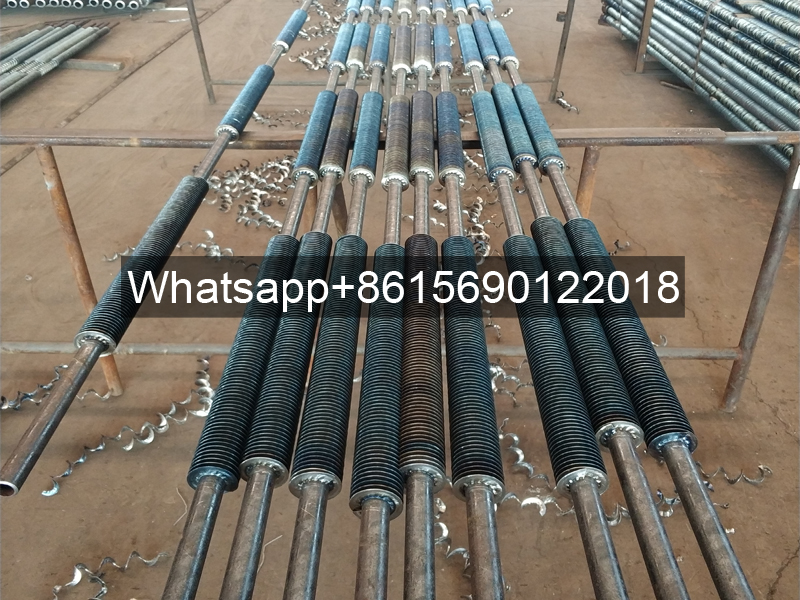
Product Name: Solid Fin Tubes | High Frequency Welded Solid Finned Pipe
- Leave Your Message
Comprehensive Analysis of Solid Fin Tubes
Definition and Structural Characteristics
Solid Fin Tube is an efficient heat transfer element that significantly increases heat exchange area by attaching continuous fin structures to the base tube surface. According to search results, Solid Fin Tube consists of two main components:
-
Base Tube: Typically made of materials like seamless steel pipe, stainless steel pipe, or copper pipe, offering good pressure resistance and corrosion durability to withstand system pressure and thermal medium erosion in heating applications.
-
Fins: Tightly arranged on the base tube surface and securely connected through welding, extrusion, or other processes. The defining feature of Solid Fins is their continuous surface without gaps, in contrast to the serrated edges of Serrated Fins.
Manufacturing Processes
The production technologies for Solid Fin Tubes include:
-
High-Frequency Welding: The most mainstream industrial production method, where high-frequency current melts the contact surfaces between fins and base tube to create metallurgical bonds, with high production efficiency (daily capacity of 500-800 meters per production line).
-
Cold Rolling Process: Forms fins on the base tube surface at room temperature through roller pressure, achieving high precision but with lower fin height (generally <10mm), suitable for ductile metals like copper and aluminum.
-
Hot Rolling Process: Performs rolling on high-strength materials like steel at elevated temperatures, capable of producing taller fins (>10mm) but with relatively lower precision.
-
Welding Processes: Including brazing, argon arc welding, etc., for attaching fins to the base tube surface.
Application Fields
Due to their efficient heat transfer characteristics, Solid Fin Tubes are widely used in multiple domains:
-
Industrial Manufacturing:
- Petrochemical industry: Used in reboilers, condensers, etc.
- Power energy: Waste heat boilers for gas turbines, nuclear seawater cooling systems
- Metallurgical industry: Hot blast stoves for blast furnaces, oil cooling systems for rolling mills
-
Special Applications:
- Data center cooling: Copper finned tube arrays for immersion liquid cooling
- Agricultural greenhouses: Heating systems for greenhouses
- Building heating: Finned tube radiators
-
Other Fields:
- Chemical reaction temperature control
- Industrial workshop ventilation
- Automotive cooling systems
Comparison with Serrated Fins
| Comparison Item | Solid Fin Tube | Serrated Fin Tube |
|---|---|---|
| Structural Characteristics | Continuous surface without gaps | Serrated edges |
| Manufacturing Process | Relatively simpler process | Requires precise serration machining |
| Heat Transfer Efficiency | Stable heat transfer efficiency | Enhances fluid turbulence, higher heat transfer coefficient |
| Cost | Lower production cost | Higher production cost |
| Application Scenarios | Conventional heat transfer needs | High-efficiency heat transfer requirements |
Serrated Fins effectively enhance fluid turbulence, improving convective heat transfer coefficients, particularly suitable for gas heat exchange applications, while also reducing dust accumulation. Solid Fins offer simpler manufacturing and lower costs, making them ideal for conventional heat transfer needs.
Performance Parameters
Based on search results, the main performance parameters of Solid Fin Tubes include:
-
Material Parameters:
- Common materials: Aluminum alloys (6063, 6061), copper, stainless steel
- Thermal conductivity: Aluminum 167W/(m·K), Copper 398W/(m·K)
-
Structural Parameters:
- Fin thickness: 0.1-0.8mm
- Fin height: 5-20mm
- Fin pitch: Up to 15mm
-
Performance Parameters:
- Working pressure: 1.2-1.5 times design pressure
- Operating temperature: -20°C to 800°C (depending on material)
Summary
Solid Fin Tube is an efficient heat transfer element that enhances thermal efficiency by increasing heat dissipation surface area, featuring simple structure, mature manufacturing processes, and relatively low cost. While its heat transfer efficiency is slightly lower than Serrated Fins, it performs exceptionally well in conventional heat transfer applications, widely used in industrial manufacturing, power energy, building heating, and other fields. When selecting Solid Fin Tubes, factors such as operating environment, medium characteristics, and budget constraints should be comprehensively considered.