

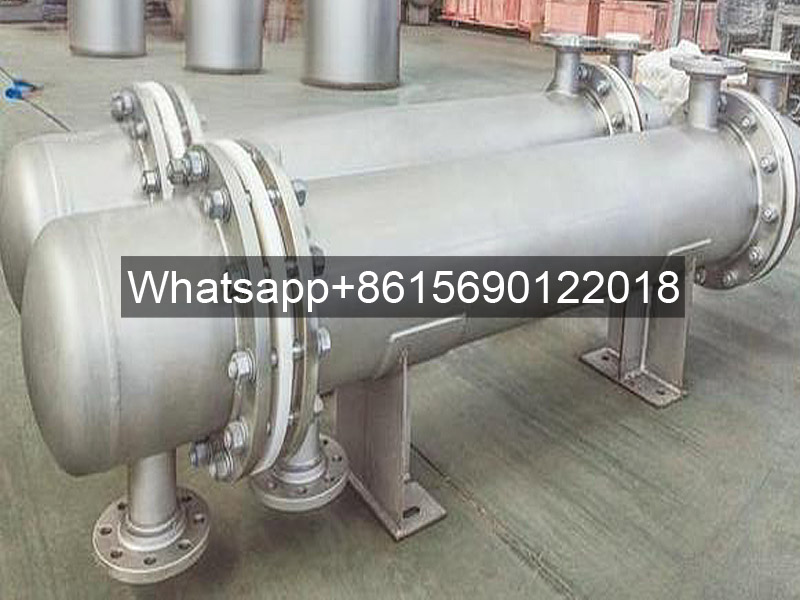
Product Name: Condensing Unit Cicle (Shell-and-tube Condenser)
- Leave Your Message
Condensing Unit Cicle (Shell-and-tube Condenser)
I. Technical Principle: Synergistic Innovation of Indirect Heat Transfer and Structural Optimization
The circulating water shell-and-tube condenser achieves steam condensation through indirect heat exchange. Its core structure includes a tube bundle, shell, tube sheet, and baffles.
High-temperature steam flows in the shell side, while circulating water flows counter-currently in the tube side, exchanging heat through the tube walls. After releasing latent heat, the steam condenses into a liquid, while the circulating water, heated, flows out, completing heat recovery.
Helical wound tube design: Multiple sets of copper or stainless steel tubes are wound around a central tube at a specific pitch, forming a compact heat exchange tube bundle. The heat exchange area per unit volume is 2-3 times that of traditional shell-and-tube condensers, and the equipment diameter can be reduced by 40%, making it particularly suitable for space-constrained environments.
Double shell-and-tube structure: A baffle divides the shell side into two independent flow regions, allowing the gaseous working fluid to achieve “secondary flow,” extending the contact path with the tube bundle. Experimental data shows that the heat transfer coefficient is increased by 15%-20%, and pressure loss is reduced by more than 10%.
Baffle plate enhanced turbulence: By altering the fluid flow direction, the shell-side turbulence intensity is increased, raising the heat transfer coefficient by 20%-40% and achieving a heat recovery efficiency of over 90%.
II. Core Advantages: Triple Breakthrough in Efficiency, Reliability, and Economy
High-Efficiency Heat Exchange and Energy Saving
Counter-flow heat exchange design: Hot and cold fluids flow in opposite directions, maximizing temperature difference utilization and achieving a heat recovery efficiency exceeding 90%. For example, in waste heat recovery from chemical tail gas, a single unit can reduce CO₂ emissions by over 5000 tons annually.
Helical tube bundle enhanced heat transfer: High-efficiency heat transfer tube types such as threaded tubes and corrugated tubes disrupt the fluid boundary layer, improving the convective heat transfer coefficient. After application in a petrochemical company, condensation efficiency increased by 30%, and energy consumption decreased by 15%.
Compact Structure and Space Optimization
Large heat exchange area per unit volume: With the same processing capacity, the equipment occupies 30%-50% less floor space than traditional equipment, suitable for space optimization in new projects and renovation of existing projects.
Modular Design: Supports single-tube bundle replacement, reducing maintenance time by 70% and annual maintenance costs by 40%. For example, the four-pass design in the vacuum concentration process of the pharmaceutical industry improves thermal efficiency by 45%.
Adaptable to Complex Operating Conditions
Diverse Materials: 304 stainless steel, 316L stainless steel, titanium alloy, etc., are selected according to the characteristics of the medium, resistant to acid, alkali, and salt corrosion. Titanium alloy equipment has operated continuously for 8 years without corrosion in the seawater desalination field, with a lifespan twice that of 316L stainless steel.
High Temperature and High Pressure Resistance: Silicon carbide ceramic tube bundles can withstand temperatures up to 1800℃. Combined with graphene-reinforced composite materials, they have been successfully applied to the molten salt condensation system of the fourth-generation sodium-cooled fast reactor.
Intelligent Operation and Maintenance
Digital Twin Technology: Optimizing tube bundle arrangement through CFD-FEM coupled simulation reduces pressure drop by 15% and increases heat exchange area by 10%. A nuclear power plant waste heat recovery project achieved a fault prediction accuracy rate of 92% and reduced unplanned downtime by 75%.
III. Application Scenarios: Covering Diverse Needs Across the Entire Industry Chain
Chemical Industry
Organic Solvent Condensation and Recovery: Suitable for condensing solvents such as methanol and ethanol, reducing energy waste and environmental pollution.
Process Tail Gas Waste Heat Recovery: In PTA production projects, the spiral groove tube structure improves the heat recovery efficiency of the oxidation reaction by 18%, reducing CO₂ emissions by 80,000 tons annually.
Power Industry
Steam Turbine Exhaust Steam Condensation: As an auxiliary cooling device for generator sets, it improves power generation efficiency. After application in a thermal power plant, waste heat utilization increased by 30%, saving over one million tons of water annually.
Supercritical Unit Feedwater Heating: The double-shell design improves regenerative efficiency by 8%, and the system thermal efficiency exceeds 60%.
Refrigeration and Air Conditioning Industry
Refrigerant Condensation: Used for condensing refrigerants (such as R32 and R410A) in chiller units, increasing the unit’s COP (coefficient of performance) by 0.3-0.5 and reducing operating energy consumption.
Cryogenic Operations: In the -30℃ pharmaceutical cold chain, temperature fluctuations are <±0.5℃, meeting GMP aseptic standards.
Nuclear Energy Field
Reactor Cooling System: Silicon carbide-coated fuel spheres withstand temperatures up to 1600℃, avoiding the hydrogen embrittlement risk associated with zirconium alloy cladding under accident conditions. A matching shell-and-tube condenser achieves highly efficient heat exchange between helium coolant and secondary-side steam, with a system thermal efficiency of 45%.
Waste Management: In the CCUS system, 98% CO₂ gas liquefaction efficiency is achieved at -55℃, avoiding the leakage risk caused by hydrogen embrittlement in traditional metal equipment.