Project Description
Product Name: Axial Flow Fan | Heat Transfer Fan | Air Cooler Fan
- Leave Your Message
What is an Axial Flow Fan?
An axial flow fan is a widely used type of fan where the airflow direction is the same as the axis of the impeller. Examples include electric fans and air conditioner outdoor unit fans. It’s called “axial flow” because the gas flows parallel to the fan axis. Axial flow fans are typically used in applications requiring high flow rates but low pressure. An axial flow fan is fixed in position and moves air.
Basic Principle of Axial Flow Fans
Ordinary axial flow fans can be used for ventilation in factories, warehouses, offices, and residences. They can also be used in evaporators, dust suppression systems, etc. There are also mining axial flow fans. Corrosion-resistant and explosion-proof axial flow fans use corrosion-resistant materials and explosion-proof measures, and are equipped with explosion-proof motors. They can be used to transport explosive, volatile, and corrosive gases.
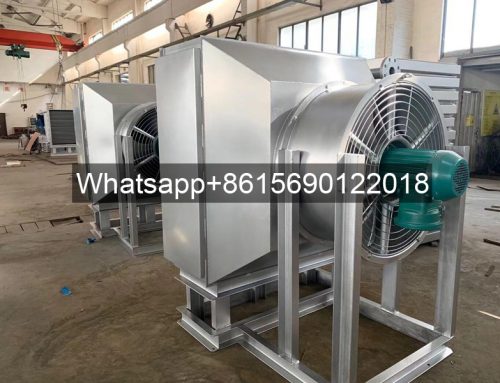
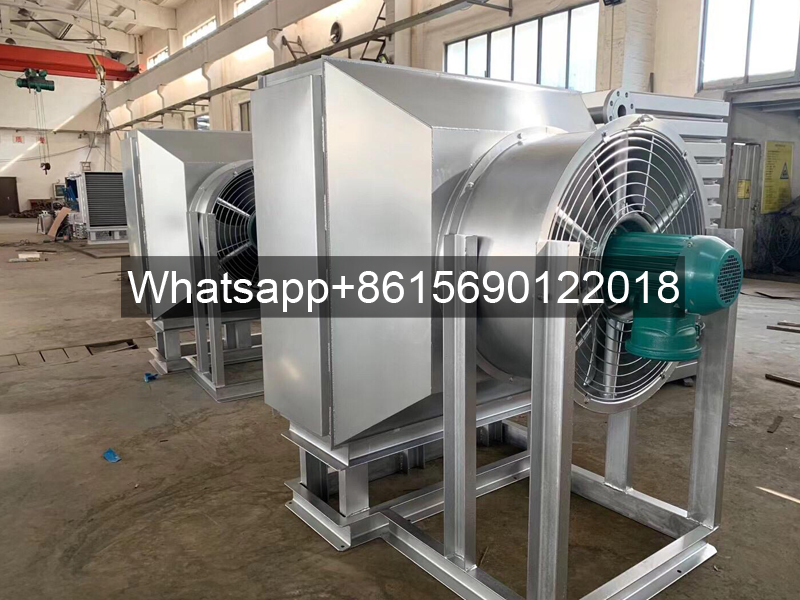
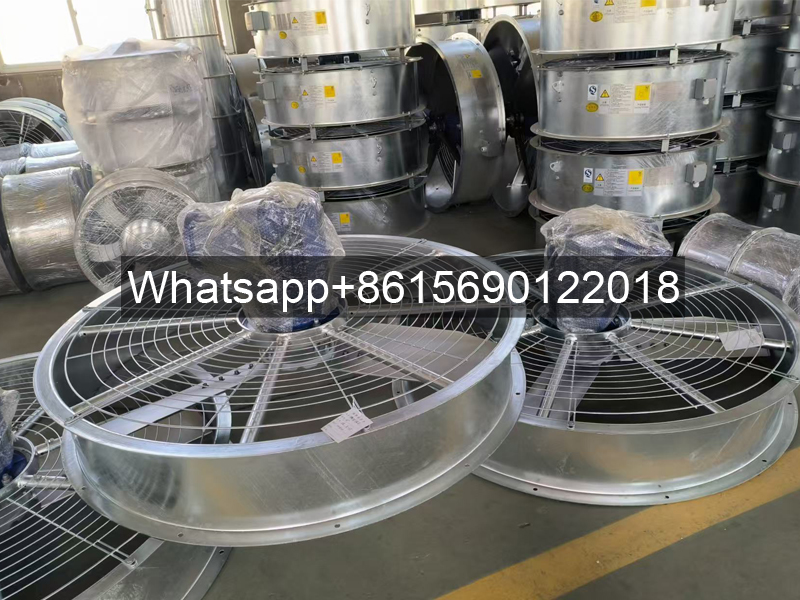
An axial flow fan mainly consists of an impeller, casing, and motor. The support frame is made of steel and connected to the casing and fan duct. The impeller and casing of corrosion-resistant axial flow fans are made of fiberglass, while other types of axial flow fans are generally made of steel plates.
Axial Flow Fan Working Principle
When the impeller rotates, gas enters the impeller axially from the inlet. It is then pushed by the blades on the impeller, increasing its energy, and flows into the guide vanes. The guide vanes deflect the airflow, changing it to axial flow, and simultaneously guide the gas into the diffuser, further converting the gas’s kinetic energy into pressure energy, and finally introducing it into the working pipeline.
The working principle of axial flow fan blades is similar to that of an aircraft wing. However, the latter applies lift upwards to the wing to support the weight of the aircraft, while the axial flow fan is fixed in position and moves the air.
The cross-section of an axial flow fan is generally an airfoil. The blades can be fixed in position or rotate around their longitudinal axis. The angle between the blades and the airflow, or the blade spacing, can be fixed or adjustable. The ability to change the blade angle or spacing is one of the main advantages of axial flow fans; a smaller blade spacing and angle will produce a lower flow rate, while increasing the spacing will produce a higher flow rate. Advanced axial flow fans can change the blade spacing during operation (similar to helicopter rotors), thus changing the airflow accordingly. This is called a variable blade (VP) axial flow fan.
Applications of Axial Flow Fans
Axial flow fans, also called local ventilation fans, are commonly used in industrial and mining enterprises. Unlike ordinary fans, their motor and blades are housed in a cylindrical casing, giving them a cylindrical shape. They are used for localized ventilation, are easy to install, provide significant ventilation and air exchange, are safe, and can be connected to ductwork to deliver air to a designated area.
Classification of Axial Flow Fans
Axial flow fans can be classified according to their characteristics as follows:
By Material: Steel fans, fiberglass fans, plastic fans, PP fans, PVC fans, magnesium alloy fans, aluminum fans, stainless steel fans, etc.
By Application: Explosion-proof fans, corrosion-resistant fans, temperature-resistant fans, special-purpose axial flow fans, etc.
Axial flow fans can be classified according to usage requirements: duct type, wall-mounted type, stationary type, fixed type, rainproof and dustproof type, mobile type, and external motor type.
According to installation method, they can be classified as: belt-driven type and direct-drive type.
Axial Flow Fan Energy-Saving Retrofit
When starting an axial flow fan, the motor current is 5-6 times higher than the rated current, which not only affects the motor’s lifespan but also consumes a lot of electricity. While the system design includes a certain margin in motor selection, and the motor speed is fixed, in actual use, sometimes lower or higher speeds are required. Therefore, frequency converter retrofitting is essential.
Frequency converters can achieve soft starting of the motor, achieving energy-saving speed regulation by changing the frequency of the equipment’s input voltage. They also provide overcurrent, overvoltage, and overload protection functions.
Axial Flow Fan Applications
They can be used for ventilation or enhanced heat dissipation in metallurgical, chemical, light industrial, food, pharmaceutical, mechanical, and civil building applications. If the casing is removed, it can also be used as a free-flowing fan, or installed in series at intervals within a long exhaust duct to increase the air pressure within the duct.
Axial Flow Fan Features:
Small Axial Flow Fans: Low power consumption, fast heat dissipation, low noise, energy saving and environmental protection. Due to their small size, they have a wide range of applications.
Large Axial Flow Fans: Features include simple structure, robust reliability, low noise, large air volume, and a wide range of functional options.